Trump's shadow looms over India-EU trade deal
1/28/20263 min read
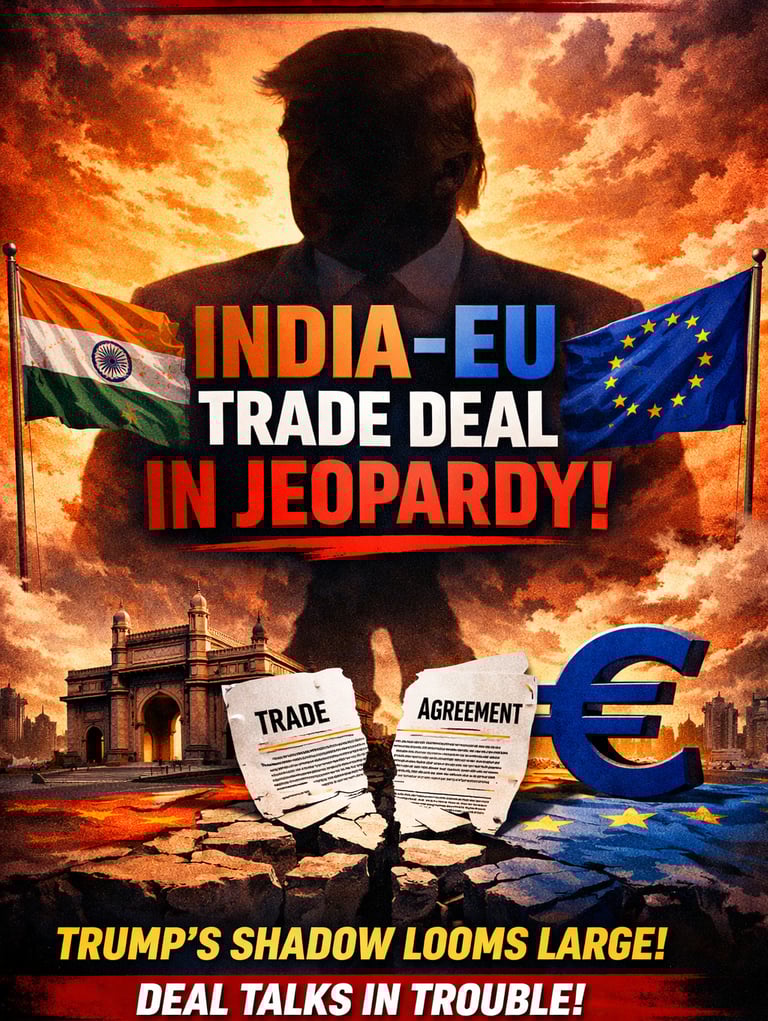
The proposed trade agreement between India and the European Union is not merely a commercial arrangement; it is deeply rooted in today’s shifting geopolitical realities. While trade is at its core, global power dynamics have played a decisive role in pushing both sides toward an agreement that had remained elusive for decades.
The EU already stands as India’s largest trading partner. In 2024 alone, trade in goods between the two reached over $142 billion, accounting for more than 11% of India’s total trade volume. India, in turn, ranks as the EU’s ninth largest trade partner. Despite these strong figures, negotiations between the two stalled for nearly 20 years, raising an obvious question: why now?
The answer lies in the rapidly changing global order and the uncertainty surrounding US trade policy, particularly under President Donald Trump. His administration has frequently used tariffs as a political weapon, not only against rivals but also against long-standing allies. India has faced steep US tariffs, including punitive measures linked to its continued purchase of Russian oil. Several European countries have also recently felt pressure from Washington, especially after disagreements over geopolitical issues such as Greenland.
These developments have unsettled both India and the EU, prompting them to reassess their dependence on the United States. In response, many countries have accelerated trade negotiations elsewhere to protect their economic interests. The India-EU deal fits neatly into this broader trend of nations seeking stability in an increasingly unpredictable global environment.
The agreement comes at a time when the EU has also moved quickly to finalise a long-pending trade pact with South America’s Mercosur bloc, while Canada and the UK are actively strengthening trade ties with China and India. This flurry of diplomatic and economic activity reflects a growing desire among global powers to diversify partnerships and reduce vulnerability to sudden policy shifts from Washington.
Against this backdrop, the India-EU agreement carries symbolic weight. It signals that major economies are willing to collaborate more closely to safeguard themselves from external economic pressure. Analysts suggest that US tariffs played a major role in motivating both sides to set aside unresolved issues and push the deal forward.
Both Indian Prime Minister Narendra Modi and European Commission President Ursula von der Leyen have described the agreement as historic, emphasizing its strategic importance. They highlighted that the partnership goes beyond trade, aiming to strengthen supply chains, reduce strategic dependencies, and enhance economic security at a time when global trade is increasingly politicised.
However, the deal has not been welcomed universally. US officials have criticised it, arguing that closer EU-India ties indirectly support Russia due to India’s energy imports. India has consistently rejected this argument, maintaining that its oil purchases are driven by domestic energy needs and long-standing strategic considerations.
The agreement may also reshape defence and economic alignments. For India, it offers an opportunity to expand defence cooperation with European countries and reduce over-reliance on any single supplier. For the EU, deeper access to the Indian market could help lessen its dependence on China over the long term.
That said, the road ahead is far from smooth. The agreement still requires detailed legal drafting, formal signing, and ratification by EU member states and the European Parliament. Previous trade deals suggest this process could be lengthy and politically challenging. Key issues such as agriculture, intellectual property rights, and environmental standards remain sensitive and will need careful handling.
Despite these hurdles, businesses on both sides have largely welcomed the agreement, particularly industries hit hard by US tariffs. European business groups see it as an important starting point, though many stress that successful implementation will determine its true value.
While US trade policies may have accelerated the timing of the deal, they are not the sole reason behind it. India and the EU resumed serious negotiations in 2022, reflecting India’s broader shift toward opening its markets and signing more free trade agreements.
At the same time, neither India nor the EU wants to sever ties with the United States. Both continue to view the US as a crucial economic partner. However, if this agreement strengthens their position in future negotiations with Washington, it will be seen as a strategic win.
How the Trump administration will ultimately respond remains uncertain — a fitting reflection of the unpredictability that helped bring this deal to life in the first place.