Breaking News
US President Donald Trump has warned Canada of imposing a 100% tariff on all its goods if it moves ahead with any trade deal with China. The threat comes amid rising tensions, despite Canada saying it is not pursuing a free trade agreement with Beijing.
1/25/20262 min read
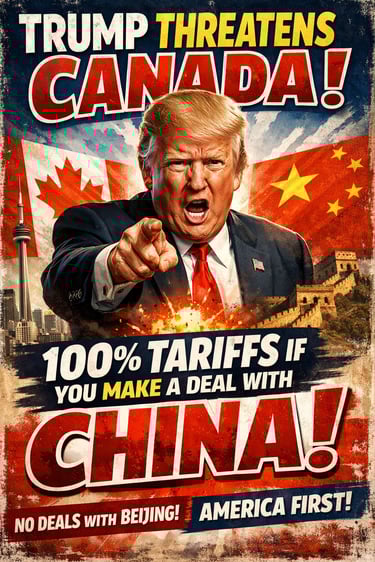
US President Donald Trump has warned that Canada could face sweeping trade penalties if it moves closer to China on economic cooperation. He said that any agreement between Ottawa and Beijing would result in a 100% tariff on all Canadian goods entering the United States.
In a post on his Truth Social platform, Trump claimed that if Canada were to strike a deal with China, the tariffs would be imposed immediately. However, he did not clearly specify which agreement he was referring to.
The warning follows an announcement last week by Canadian Prime Minister Mark Carney, who revealed a new “strategic partnership” with China that includes easing certain trade restrictions. At the time, Trump had described the development positively, but relations between the two countries have since become more strained.
Tensions increased further after Carney said at the World Economic Forum in Davos that the US-led global system had been disrupted. He also encouraged so-called “middle powers” to cooperate in response to economic pressure from larger nations, without directly naming the United States or Trump.
Trump responded the following day, asserting that Canada’s economic survival depends heavily on the US. He later revoked Canada’s invitation to join his newly announced Board of Peace.
In another social media post on Saturday, Trump accused Carney of trying to turn Canada into a transit hub for Chinese goods destined for the US, a claim he strongly rejected.
The BBC has reached out to both the White House and the Canadian prime minister’s office for official responses.
Canada’s Minister of Intergovernmental Affairs and Trade with the US, Dominic LeBlanc, said there are no plans for a free trade agreement with China. He clarified that recent discussions were limited to resolving specific tariff-related issues.
LeBlanc added that the government’s priority is to strengthen Canada’s economy and expand trade relationships globally.
Canada has been actively working to reduce its dependence on the US market, its largest trading partner, amid uncertainty caused by Trump’s unpredictable tariff policies.
Under the recent agreement between Carney and Chinese President Xi Jinping, China will cut tariffs on Canadian canola oil from 85% to 15% by March. In return, Canada will lower taxes on Chinese electric vehicles to 6.1%, down from 100%, aligning with most-favoured-nation rates.
The agreement is widely viewed as a significant step forward after years of trade disputes and retaliatory tariffs, and it may open the door for increased Chinese investment in Canada.
Carney said the improved relationship with China positions Canada strongly in what he described as an emerging global order.